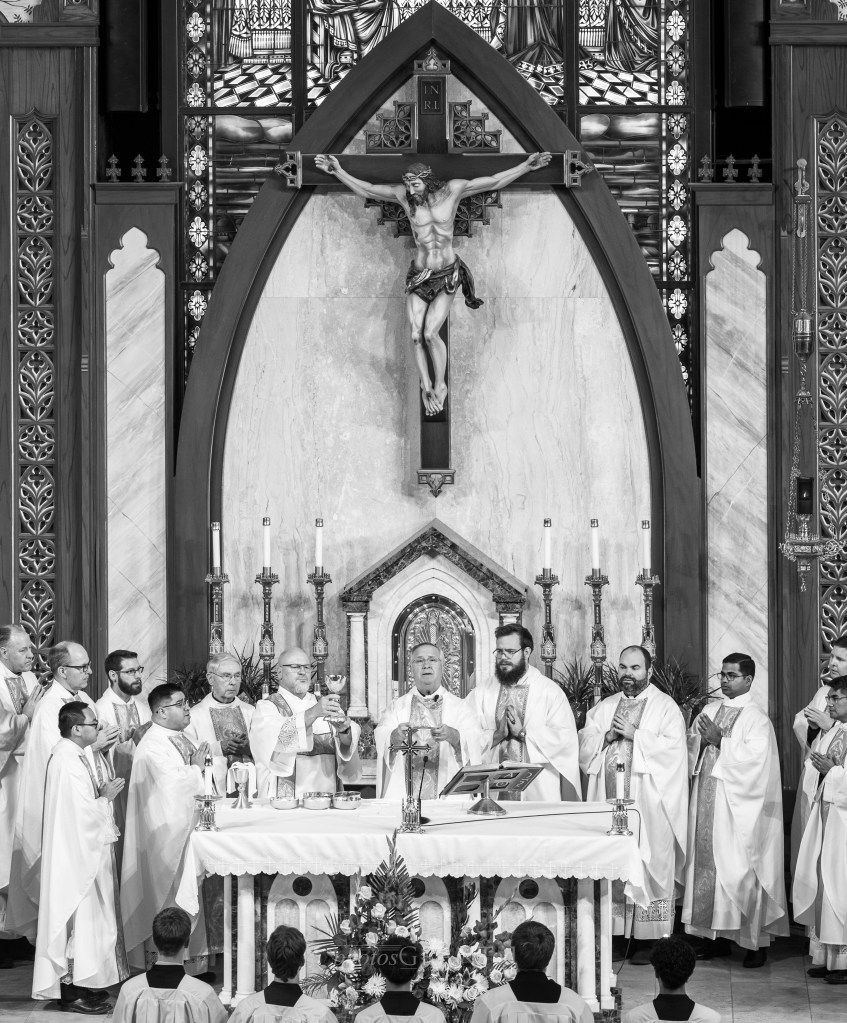
How should we approach the Sacrament of the most Holy Eucharist during Mass? The answer can be found in the words and actions of Eucharistic Prayer I, especially the Intercession and in the prayers asking God to accept our offering. In these two sections of Eucharistic Prayer I, we can see the roadmap to how we should orientate our hearts and minds before receiving Christ.
The first step in approaching the Eucharist is to recognize ourselves as sinners in need of mercy. The first step comes from a perhaps overlooked gesture the priest makes in the Intercession. The priest says, “To us, also, your servants, who, though sinners” and the priest moves his right hand over his heart at the words, “though sinners” to signify that he too is counted among those who are sinners. How powerful is it that after the priest has consecrated the Eucharist he admits with word and gesture that he too is included in those who are sinners. This isn’t to invalidate the consecration, instead it is a reminder that we are all sinners who need mercy.
The same line goes on to say, “though sinners, hope in your abundant mercies” and the Intercession ends with, “admit us, we beseech you, into their company, not weighing our merits, but granting us your pardon, through Christ our Lord.” The part about recognizing our sin is not there to lead us into despair. It is to remind us of the great mercy that Christ has in store for us. This idea is reflected in these two lines that we hope in the mercy of Christ to save us not of our own worthiness, but because we are not worthy. If we remember both parts of this, we can keep ourselves from despair by hoping in Christ’s mercy and we also can keep ourselves from presuming his mercy since we recognize that we too are sinners.
The second step is to remember the Saints gone before us which is also found in the Intercession. Eucharistic Prayer I lists the Saints specifically by name with the priest saying, “with your holy Apostles and Martyrs: with John the Baptist, Stephen, Matthias, Barnabas, (Ignatius, Alexander, Marcellinus, Peter, Felicity, Perpetua, Agatha, Lucy, Agnes, Cecilia, Anastasia) and all your Saints.” The Saints listed are invoked for prayer to God on our behalf through Christ and are spiritually with us during the Mass as we pray. The Saints are there as guides for us to follow; they struggled with temptation and sin, but through the mercy of God were purified and are now enjoying eternity with Christ. For example, Peter denied Christ three times, yet he repented and went on to lead the Church on earth. The lives of the Saints are there to keep us from despair and presumption by showing us that everyone struggles with sin and therefore must hope in the mercies of Christ. As the Intercession concludes, we might ask one of the Saints listed for their prayers to Christ that we may receive the Eucharist as humble servants and act upon the graces Christ provides to us through the Eucharist.
The third step is to remember to ask God to look upon our sacrifices just as we ask God to look upon the sacrifice of the Mass. In the Anamnesis the priest says, “Be pleased to look upon these offerings with a serene and kindly countenance, and to accept them, as you were pleased to accept the gifts of your servant Abel the just, the sacrifice of Abraham, our father in faith, and the offering of your high priest Melchizedek, a holy sacrifice, a spotless victim.” In this statement the priest is asking God to look upon the sacrifice of the Mass and accept what has been offered in a similar manner to those of the Old Testament. This also shows that throughout salvation history we have offered sacrifices to God including in Church history. In life we all have small, or sometimes large, sacrifices we must make and for the most part these sacrifices don’t make us over joyful. Instead of turning to hatred or misery we can offer our sacrifices to God for purification, that through our intercession another soul might be saved or that those in purgatory might suffer less. Before we receive the Eucharist, we can ask ourselves: what am I sacrificing in my life and how can I offer that sacrifice up to God to be used for His divine purpose?
These are but small ways we can better participate in the Mass and prepare ourselves to receive Christ, truly present in the most Holy Eucharist. We must remember that we are sinners, but we are also offered abundant mercy. So that we don’t think that we deserve the Eucharist or that we are too unworthy to receive the Eucharist when we are in a state of grace. We should call upon those Saints for prayer on our behalf, that we may act on God’s grace and do his will. Finally, we should recognize our sufferings and sacrifices and offer them to God to be used by Him for other souls. This is how the Church shows us to prepare our hearts and minds before receiving Christ in the most Holy Eucharist. May we ask God for the grace to prepare our hearts to receive Christ and to carry out what God has planned for us.

You must be logged in to post a comment.