Tag: heaven

  • Standing Firm in the Gospel of Christ

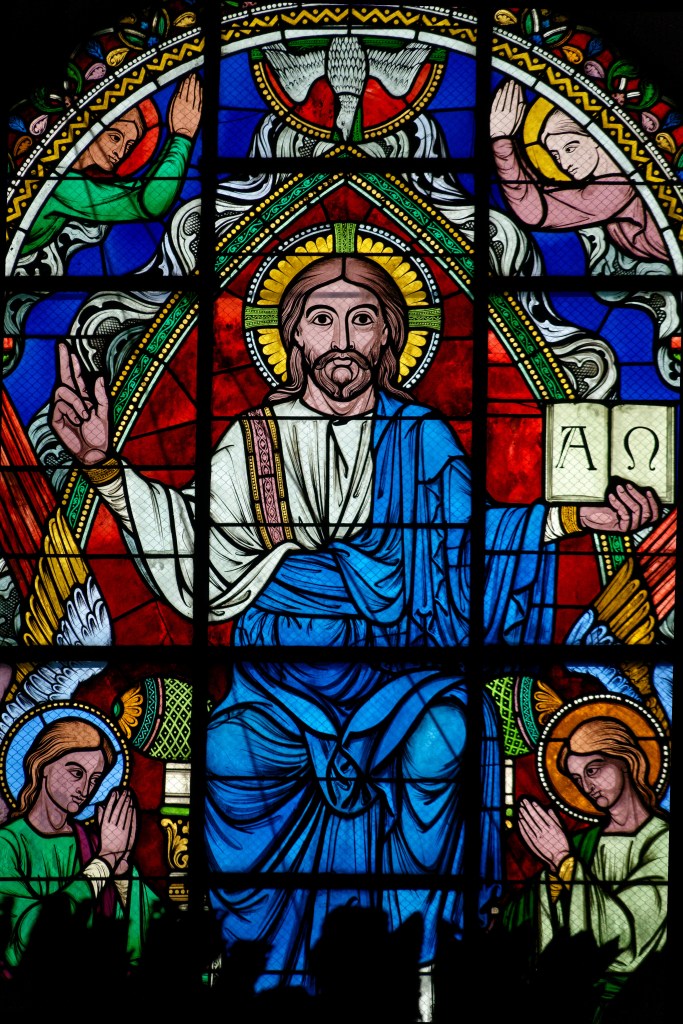
    2024-06-17, Cathédrale Saint Pierre – Angoulème, France: Stained glass (19th century) of Christ in Majesty or Christ in Glory.

    How can we maintain our hope in times where it seems like the world is unraveling in front of us? How do we continue when it seems that even truth itself is being rewritten to serve earthly powers? St. Paul tells us, “Only let your manner of life be worthy of the gospel of Christ … stand firm in one spirit, with one mind striving side by side for the faith of the gospel.” (Philippians 1:27) But how can we trust that if we live our lives worthy of the gospel that it will be enough when people who stand against truth seem to win? 

    One answer to the question can be found in the Old Testament, in a book that St. Paul would have known well. In the book of Daniel, we see the answer to the question of good versus evil. In chapter two Daniel is brought to King Nebuchadnezzar to interpret a dream the king had. The dream showed a statue made of many materials being crushed by a stone not made by human hands. Daniel interprets the dream as four kingdoms which shall rise and fall which he states, “And in the days of those kings the God of Heaven will set up a kingdom which shall never be destroyed, nor shall its sovereignty be left to another people.” (Daniel 2:44) After the passing of the four kingdoms God will establish his own kingdom that will have no earthy leader and can never be defeated. Kingdoms and countries may rise and fall throughout history, but despite how opposed to truth these governments are they shall not stand. However, we must first endure the earthly kingdoms before receiving consolation in the inheritance of the Heavenly Kingdom, but we will not be left alone in these times of the earthly rulers.

    We are shown that even when we are wrongfully persecuted under the rule of earthly powers we are still protected and guided by God. In Daniel chapter three we are shown that Shadrach, Meshach, and Abednego are bound and tossed into a fiery furnace to be consumed by the fires due to the three refusing to worship a golden idol. During the time in the furnace the three pray to God that they might be forgiven of their sins and that mercy be imparted upon them. To which an angel of the Lord was sent down to them in the furnace and not a flame touched the three. When the three men came out of the furnace it was stated, “the fire had not had any power over the bodies of those men, the hair of their heads was not singed, their mantles were not harmed, and no smell of fire had come upon them.” (Daniel 3:27) Even after being in a roaring fire the men emerged with not even the smell of smoke upon them. During our times of trials if we cling to God we are not abandoned. Instead, the Lord is with us and has his hand upon us guiding us through so that as we pass through our trials, we are not consumed by them. 

    We might say that indeed God may be with us in our trials and that the earthly kingdoms may fall, but what about the faithful that seem to be overtaken by evil? Were their sacrifices for nothing? Again, Daniel provides the answer to this question in chapter seven. In this chapter Daniel has a vison of the end times when God comes to institute his Heavenly Kingdom evil shall not prevail and the sacrifices of the faithful will be preserved. Daniel states, “As I looked, the horns waged war with the saints, and prevailed over them, until the Ancient of Days came, and judgement was given for all the saints of the Most High, and the time came when the saints received the Kingdom.” (Daniel 7:21-22) During this life it might seem that evil is prevailing over us, but at the hour of death when we receive our particular judgement, we will receive the Kingdom of Heaven if we have lived our lives for God by His grace. 

     Given the division in our society, as in the times of St. Paul, we must always live our life worthy of what the Gospel teaches us. So that when the promises given to us through Christ and the prophets are fulfilled in the judgment of Christ, we may be counted among the saints who receive the Kingdom. The reason St. Paul could tell those in his time to stand firm in truth is the same for us today because God has promised that the earthly powers will not stand, He is with us in our trials, and in the end the truth of God will prevail over evil. Let us ask God for the grace to stand strong in the Gospel and in truth that we may be heirs to the Heavenly Kingdom. 
  • Reflection on The Last Four Things

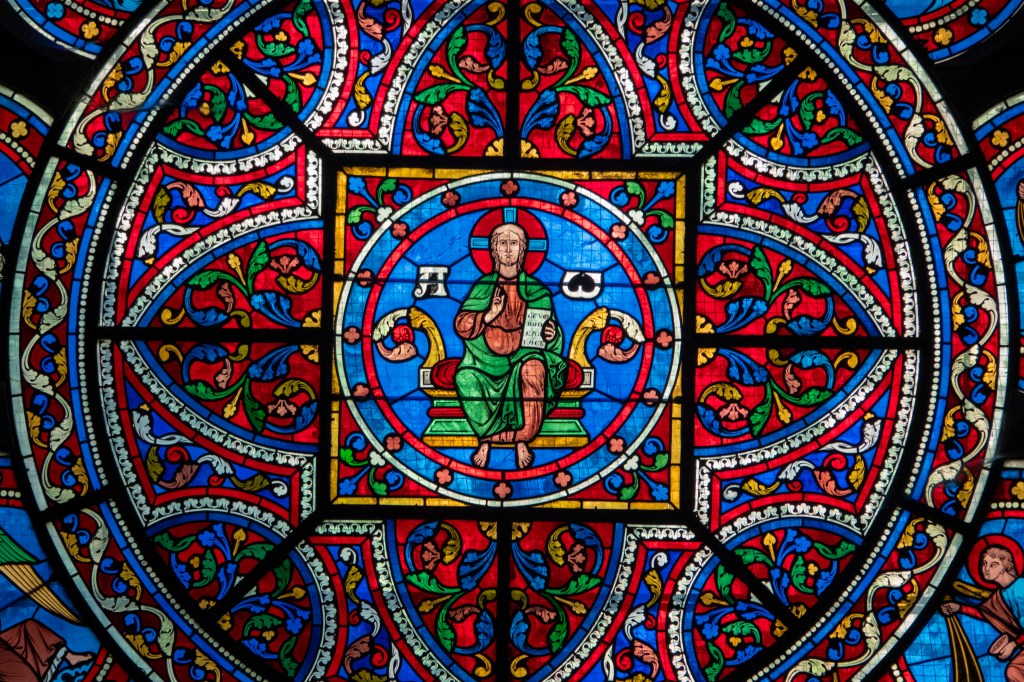
    Collegiate Church Saint Anatoile, Salins les Bains, France – 08-28-2025:

    God lights our lamp with faith, and we cooperate with his grace to fill our oil flask with good works so that when the unknown hour comes, we may see the bridegroom’s face. But what happens at that moment? What happens when we cross from this life to the next? 

    If you are like me, we often don’t like to take the time to think about what happens at the moment of our death. It seems scary, perhaps a bit morbid, but it’s worth contemplating so that we know what is to come and we can keep ourselves prepared. Between Sacred Scripture and Church teaching we gain a good overview of what those moments look like. 

    At the final moment we face Death, Judgment, Heaven or Hell. How do we know that after death we will face judgment? Scripture makes several references to particular judgement, that is the personal judgement we all face after death. The clearest reference is in the Book of Hebrews, “And just as it is appointed for men to die once, and after that comes judgement.” (Hebrews 9:27) Here the author affirms that we are to die once and then face judgment. There is no waiting period or wandering about; we are to be immediately in front of the judgment seat of Christ. 

    The Catechism also affirms this position by stating, “Each man receives his eternal retribution in his immortal soul at the very moment of his death, in a particular judgement …” (CCC 1022) Again the Church affirms that at the moment of death we are at the judgement throne without any lingering or waiting here on earth. But what does the Catechism mean when it states, “Each man receives his eternal retribution.”? That is where we receive a just judgment from Christ based on our life and how we lived in accordance with our faith and works.

    At judgement we are sent to either Heaven or Hell and that is where we will spend eternity. St. Paul states, “For we must all appear before the judgement seat of Christ, so that each one may receive good or evil, according to what he has done in the body.” (2 Corinthians 5:10) At judgement we receive our eternal destination for what we have done in this life and immediately enter either Heaven (directly or through Purgatory) or Hell. 

    Even after judgment there is still no time for wondering or “stuck” souls. The souls of the departed are immediately taken to their eternal destination. This can be seen through the Good Thief where Jesus says, “Truly, I say to you, today you will be with me in Paradise.” (Luke 23:43) Jesus didn’t say at the second coming or the fall of the temple you will be with me. Instead, Jesus immediately takes the Good Thief with him into paradise (Heaven). The same can be said about those sent to Hell as seen in the story of the Rich Man and Lazarus.

    In the story we see that once the rich man dies he is immediately in Hell. St. Luke states, “The rich man also died and was buried; and in Hades, being in torment …” (Luke 16:22-23) The rich man had no time to wander; he was immediately cast into Hades based on the just judgement he received. Regardless of the destination after judgement we are immediately sent to our eternal destinations.

    You might be wondering about a third place I’ve mentioned a couple times called Purgatory. Purgatory is similar to a transient destination that a soul may be sent to if they need purification before entering Heaven. The souls in Purgatory are assured of their eternal destination of heaven since they died in a state of grace but must be cleansed of all worldly attachments and the temporal punishment due to sin before entering Heaven. St. Paul writes, “If any man’s work is burned up, he will suffer loss, though he himself will be saved, but only as through fire.” (1 Corinthians 3:15) As St. Paul points out, we may have attachments to worldly things yet through cleansing we are still saved and purified to enter heaven. 

    I write this not to scare you dear reader, but to encourage you to turn your hearts and minds back towards God before we face the Last Four Things. For as long as we still have breath there is time to turn back to God with repentance and to let His mercy restore our soul so that we may not face the perils of Hell. St. Paul writes, “My desire is to depart and be with Christ, for that is far better. But to remain in the flesh is more necessary on your account.” (Philippians 1:23-24) Let us embody what St. Paul lived, let us desire to be with Christ when our times comes, but while we are here on earth let us be a witness to Christ for others. May we ask for the grace to see our errors and return to Christ who is there to meet us with open arms.